.png)
True Fitness & The Somatic Approach: Moving Beyond Scotland's 'Crack On' Culture

When a famous fitness icon passes away, it almost inevitably triggers the same cynical question from the public: "Well, what did all that exercise actually do for him?" At first glance, it sounds like a sobering realization. But if we look deeper, this reaction exposes one of the greatest confusions of modern culture: the hidden assumption that the ultimate goal of fitness, nutrition, and supplements is to somehow defeat death.
Biology doesn’t work like that. No biological system gets a free pass from aging. The question isn’t whether we will die; the question is how we will live until then. Reaching your seventies with muscle mass, functional independence, and mobility is not a failure of the body it is a profound biological success.
However, there is a missing link in how we view health today, and it’s causing us to actively damage our own bodies in the pursuit of "fitness."
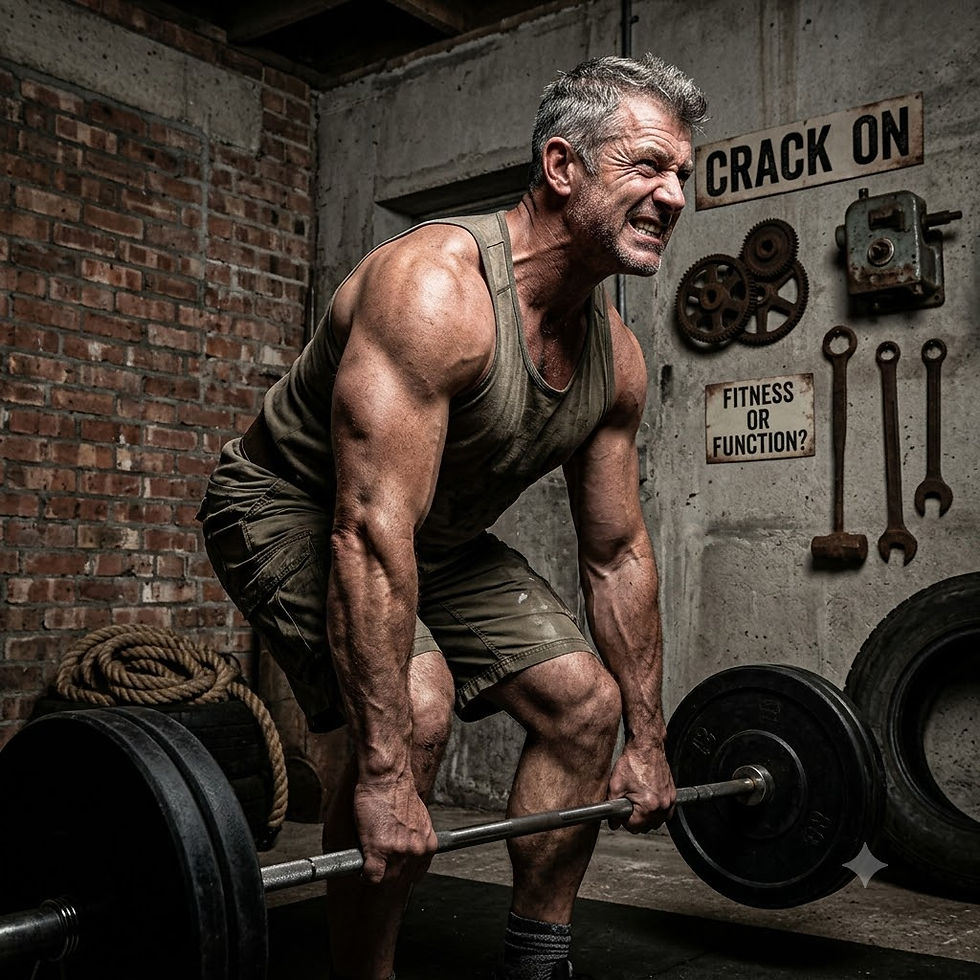
The "Crack On" Culture and the Body as a Machine
Here in Scotland, we have a deep-rooted cultural pride in stoicism. Whether it’s facing the harsh winter weather or dealing with personal hardship, the default mentality is to "crack on" and get on with it. While this resilience is a strength in many areas of life, applying it blindly to our physical bodies is a recipe for disaster.
We have been conditioned to treat our bodies like broken machines that need to be pushed, punished, and fixed. We ignore joint pain, push through sheer exhaustion, and swallow handfuls of supplements to artificially sustain an unsustainable lifestyle. We look at a muscular, heavily-trained physique and automatically label it "healthy."
But not all exercise serves the same biological purpose.
Moving from Capacity: Some people train as an expression of a stable, well-organized biological system.
Moving from Compensation: Others train out of sheer necessity—using intense physical stress to manage anxiety, restlessness, or a dysregulated nervous system.
From the outside, both individuals might look identical. From the inside, they are living in completely different biological realities.
The Clinical Reality: When Exercise Becomes a Stressor
From a Somatic Psychotherapy perspective, ignoring your body’s signals to rest is not discipline; it is dissociation.
Your nervous system cannot tell the difference between the stress of a looming deadline, financial worries, or an intense CrossFit session. To your brain, stress is stress. When we force an already exhausted body through punishing workouts, we aren't building health we are triggering Sympathetic Overdrive (the fight-or-flight response).
Clinical data on Overtraining Syndrome (OTS) highlights exactly what happens when we refuse to listen:
Hormonal Chaos: Sustained intense exercise without adequate recovery leads to chronically elevated cortisol levels (the stress hormone) and depleted testosterone.
Systemic Breakdown: OTS is clinically diagnosed through symptoms like resting tachycardia (an unusually fast heartbeat), severe sleep disturbances, persistent muscle stiffness, and a suppressed immune system.
Mental Toll: Prolonged physical strain mirrors professional burnout, leading to anxiety, irritability, and depression.
We are taking a family car and constantly revving the engine to race-car speeds, expecting it not to break down.
A Somatic Approach: Befriending Your Sensations
True health is not about performance; it is about nervous system regulation. You cannot exercise your way out of a dysregulated nervous system, and no supplement can replace the profound healing of simply learning to listen to your body.
Dr. Bessel van der Kolk, a pioneer in trauma research and somatic therapy, famously wrote in The Body Keeps the Score:
"Trauma victims cannot recover until they become familiar with and befriend the sensations in their bodies. Being frightened means that you live in a body that is always on guard... Physical self-awareness is the first step in releasing the tyranny of the past."
When you force your body through pain, you are fundamentally at war with yourself. A Somatic Approach teaches us to drop the armor. Instead of asking, "How many calories did I burn?" we need to start asking: "Does this movement make me feel grounded and safe, or does it push me further into panic and exhaustion?"
Redefining True Fitness, the Somatic Approach: Moving Beyond the "Crack On" Culture
The passing of an active 72-year-old doesn't prove that exercise failed. It simply reminds us that fitness is not immunity. A visually impressive body doesn't always tell the true story of what's happening to the nervous system inside.
It is time to stop viewing the body as an adversary that needs to be conquered. True Fitness through the Somatic Approach shows us it is not a competition against death; it is the continuous, mindful process of preserving harmony and organization within ourselves over time.


Comments