.png)
The Womb as a Temple: Understanding Biosynthesis and the Echoes of Baudelaire

Prenatal development is not merely a biological prelude but the foundational architecture of our being. While modern science details the cellular and metabolic mechanics, viewing the Womb as a Temple through the lenses of a compelling psychological model called Biosynthesis and the profound philosophy of French poet Charles Baudelaire offers a unique way to understand how this earliest chapter shapes the rest of our lives.
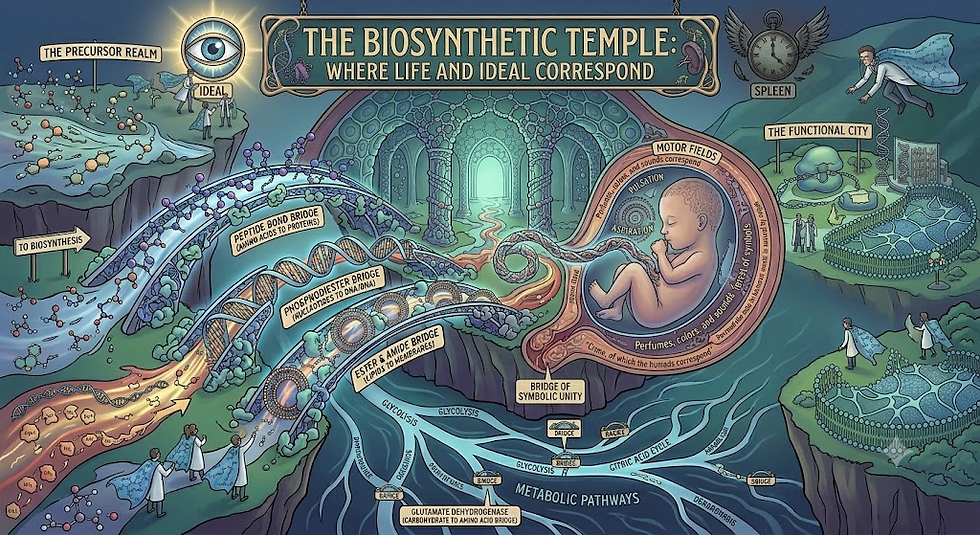
The Biosynthesis Model: The Womb’s Functional City
Developed by David Boadella, Biosynthesis frames the prenatal journey as an energetic and somatic unfolding. It posits that the fetus navigates and builds a "functional city" from the raw materials of its life. This city is not composed of concrete but of "life streams" and "motor fields."
1. The Life Streams: Flow and Nourishment
From the moment of conception, three fundamental "life streams" of energy and sensation are said to connect the developing being:
The Metabolic Stream: This is the flow of fuel. The physical link the placenta provides glucose, oxygen, and nutrients. Energetically, it is the fundamental sensation of being fed, of having what is needed.
The Emotional/Hormonal Stream: This stream is the "atmosphere" of the womb, shaped by the mother’s endocrine system. It transmits her emotional states calm, stress, joy creating an emotional climate the fetus absorbs and reacts to.
The Sensori-Motor Stream: This is the stream of experience. A fetus is not a passive passenger; it perceives, moves, and reacts. Its skin, the largest sensory organ, experiences the touch and pressure of the amniotic fluid and womb walls, laying the groundwork for how it will eventually "touch" the world.
2. The Motor Fields: The Blueprint of Action
The Biosynthesis model suggests that these life streams organize into "motor fields" patterns of movement that reflect the fetus's psychological intent. A fetus develops fields for:
Pulsation: The basic rhythm of life, expanding and contracting.
Aspiration: Reaching, exploring, or pulling in.
Orientation: Turning toward a sound or comfort, or away from a perceived discomfort.
In an ideal pregnancy, these fields develop freely and harmoniously. A child whose motor fields are blocked for instance, by maternal stress that tightens the womb environment may develop defensive patterns (like hyper-vigilance or withdrawal) that persist into adulthood. The womb, in this view, is the first training ground for how we will physically and emotionally act in the world.
Baudelaire’s Perspective: Spleen, Ideal, and the Forest of Symbols
To view this biological and psychological architecture through the eyes of Charles Baudelaire (1821–1867) is to introduce a profound moral and aesthetic duality. Baudelaire, famous for his collection Les Fleurs du Mal (The Flowers of Evil), was a poet of contrasts, obsessively exploring the clash between "Ideal" (the sublime, infinite perfection) and "Spleen" (the crushing weight of time, boredom, and dissatisfaction).
How does this affect our lives? Baudelaire's work provides a striking commentary on the entire prenatal experience.
1. The Womb as a Temple: A Forest of Symbols
Baudelaire would likely see the womb as the archetype of the "Ideal." In his famous sonnet "Correspondences," he describes nature as a temple, a "forest of symbols" where sensory perceptions perfumes, colors, sounds blend into a "deep and tenebrous unity."
"...Like prolonged echoes that from afar Mingle in a deep and tenebrous unity, Vast as the night and as the light, Perfumes, colors, and sounds correspond." Charles Baudelaire, from "Correspondences"
For the fetus, the womb is this temple. In a pre-linguistic, pre-conceptual state, its existence is a pure act of synesthesia. The taste of amniotic fluid, the muffled sounds of the mother’s voice, the touch of the womb, the light filtering through the abdomen all these are a unified, symbolic experience, an ultimate correspondence that our adult minds struggle to recreate only through art or ecstasy. To exist in the Womb as a Temple is to exist within the Ideal, before the separation of self and world, before the tyranny of time.
2. Birth as the Fall into Spleen: The Taint of "Original Sin"
But for Baudelaire, perfection is naturally corruptible, and life is an artificial deformation of a sublime order. While Biosynthesis views development as a positive path, Baudelaire offers a more radical perspective: a sense of innate corruption. In The Painter of Modern Life, he writes:
"Crime, of which the human animal has learned the taste in his mother's womb, is natural by origin."
This startling assertion suggests that the very act of existing and consuming the "metabolic life stream" carries a profound moral weight. Baudelaire implies that the fetus is not entirely innocent; it already participates in the "natural" violence and egoism of survival. Virtue, for him, must be constructed, artifice over nature.
3. How Baudelaire Says This Affects Our Lives
Baudelaire's worldview suggests two key ways this prenatal experience affects our adult lives:
The Nostalgia for the Infinite: Our entire lives are driven by a subterranean, desperate nostalgia for that initial, perfect "tenebrous unity." Our desire for love, our creation of art, and our pursuit of spiritual experiences are echoes of the womb. They are our attempts to find our way back to the "Forest of Symbols."
The Inevitability of Spleen: However, because we were born into time, because we "learned the taste of crime," we can never fully recapture that perfection. This failure, for Baudelaire, is the source of "Spleen": the profound, unprovoked melancholy and dissatisfaction that haunts modern life. Our adult existence is a perpetual state of exile, haunted by the shadow of an Ideal we can only vaguely remember.
The Biosynthesis model and the philosophy of Baudelaire provide complementary views of prenatal life. Biosynthesis offers a somatic blueprint, showing how the functional and energetic flows in the womb structure our very being. Baudelaire provides the philosophical and moral depth, viewing that initial state as both our greatest perfection and the origin of our inherent corruption. Together, they suggest that to understand our adult lives—our actions, our desires, and our profound dissatisfactions we must look back to that earliest and most mysterious of sanctuaries, forever revering the Womb as a Temple.


Comments